Pedigree, Genetics, Structure, and the Generations Behind Our American Bullies
Every American Bully has a pedigree, but understanding what that pedigree represents requires more than recognizing famous names.
At Capcity Bullys, we believe that understanding American Bully bloodlines is an essential part of building a responsible, consistent breeding program. A dog’s ancestry can provide valuable information about the characteristics appearing across generations, including structure, size, temperament, and physical development.
Our breeding philosophy is built around three principles:
Power, Pedigree & Precision.
We appreciate the powerful, compact appearance of the Micro American Bully, but our breeding decisions involve more than producing a particular look. We consider pedigree compatibility, functional structure, temperament, health information, and the long-term direction of our program.
From established influences such as Bape, Bullsace, Devilspit, and Miagi to more recent combinations involving Crown, Honey Badger, and other influential dogs, our goal is to understand how generations of selective breeding shape the American Bullies we produce.
This guide explains what American Bully bloodlines are, why they matter, and how pedigree knowledge influences our breeding program.
What Are American Bully Bloodlines?
An American Bully bloodline refers to a family of dogs connected through ancestry, often associated with particular breeding programs, influential sires, or recognizable physical characteristics.
Over time, selective breeding can produce families of dogs that share certain traits.
These may include:
- Head shape and overall proportions
- Bone structure and muscular development
- Height and body length
- Chest width and shoulder development
- Temperament and behavioral tendencies
- Movement and structural balance
- Coat colors and inherited characteristics
Some bloodlines become well known because particular dogs consistently appear in the pedigrees of successful breeding programs.
However, a bloodline is not a guarantee of quality.
Two dogs may share a famous ancestor while differing significantly in health, structure, temperament, and overall appearance.
At Capcity Bullys, we believe a pedigree should help guide breeding decisions—not replace the evaluation of the individual dog.
Why American Bully Bloodlines Matter in a Breeding Program
Understanding ancestry helps breeders make more informed decisions about which dogs may complement one another.
A carefully studied pedigree can reveal patterns that may not be obvious from a photograph.
1. Predictability and Consistency
One goal of selective breeding is to develop greater consistency across generations.
When certain characteristics repeatedly appear within a family of dogs, breeders may gain a better understanding of the traits that could appear in future offspring.
For example, a family may be known for compact proportions, substantial bone, or a particular head type.
However, inheritance is complex. Even closely related dogs can produce puppies with considerable variation.
2. Structural Compatibility
Pedigree knowledge can help breeders evaluate potential combinations, but it must be considered alongside the actual structure of both parents.
A breeder should examine characteristics such as:
- Overall balance
- Front and rear assembly
- Topline
- Leg alignment
- Chest proportions
- Movement
- Breathing and physical comfort
The goal should be to avoid reinforcing structural weaknesses while preserving desirable characteristics.
3. Temperament Considerations
Temperament is an important part of responsible American Bully breeding.
A confident, manageable companion requires more than an impressive physical appearance.
Genetics can influence behavioral tendencies, while socialization, training, environment, and individual experiences also contribute to temperament.
At Capcity Bullys, we value stable, people-oriented dogs and appropriate early puppy development.
4. Genetic Health Awareness
Pedigrees can help breeders identify relationships and potential inherited risks.
However, pedigree research alone is not health testing.
Responsible breeding decisions should also consider veterinary history, appropriate health screening, known hereditary conditions, and the degree of relatedness between prospective parents.
A famous ancestor does not eliminate genetic risk.
For a deeper look at the science behind breeding decisions, explore the educational resources at The American Bully Breed, including its genetics and health-focused academies.
Influential American Bully Bloodlines in the Capcity Bullys Program
The American Bully has developed through generations of selective breeding, with different families and breeding programs contributing to the breed’s appearance and characteristics.
At Capcity Bullys, several recognizable bloodline influences appear throughout our pedigrees.
Each contributes to the genetic background we study when evaluating our dogs and planning future breedings.
Bape Bloodline — A Recognizable Influence in Compact American Bullies
Bape is a prominent name among enthusiasts of compact American Bully pedigrees.
Dogs carrying Bape ancestry are frequently discussed in breeding circles focused on substantial bone, muscular development, and compact proportions.
At Capcity Bullys, Bape influence appears in several areas of our program.
Raven, for example, carries doubled-up Bape ancestry, while Mayor is a Bape grandson.
Our pedigrees also include combinations that bring Bape influence together with other established bloodlines.
These relationships are valuable to study, but they do not mean every descendant will share the same physical characteristics.
We evaluate each dog individually.
Bullsace Bloodline — Generational Pedigree Influence
Bullsace is another important name within the ancestry of several Capcity Bullys dogs.
Our stud Youngblood is a Bullsace son, making Bullsace a direct influence in that portion of our breeding program.
Youngblood’s daughters, including Storm and Kisses, carry this ancestry into subsequent generations.
This gives us an opportunity to study how related dogs develop and how their characteristics may appear in future combinations.
For example, our Icon × Storm breeding combines Icon’s pedigree influences with Storm’s Youngblood and Bullsace ancestry.
This type of breeding illustrates why pedigree knowledge is useful: it allows us to examine the characteristics and family histories contributed by both sides.
Devilspit Bloodline — Part of Our Micro Bully Foundation
Devilspit ancestry is another recognizable component of the Capcity Bullys program.
Our stud Icon carries Giagi/Miagi and Devilspit influences, while other dogs in our program also carry Devilspit-related ancestry.
We consider this background when studying pedigree compatibility and evaluating the physical characteristics of potential breeding pairs.
Rather than assuming a particular ancestor will automatically produce a certain result, we look at the actual dogs and their family histories.
Miagi Bloodline — An Influential Name in Micro Bully History
Mr. Miagi is widely recognized among Micro Bully enthusiasts.
Miagi-related pedigrees have been influential in breeding programs focused on short, compact American Bullies with distinctive breed characteristics.
At Capcity Bullys, Miagi influence appears in portions of our breeding program, including the ancestry associated with Icon and Harmony.
Because Micro Bully is an informal size designation rather than a separate ABKC-recognized variety, we believe buyers and breeders should evaluate actual height, proportions, movement, and health rather than relying solely on pedigree labels.
Crown Bloodline — Studying Generational Influence
Crown ancestry is another bloodline influence of interest within the American Bully community.
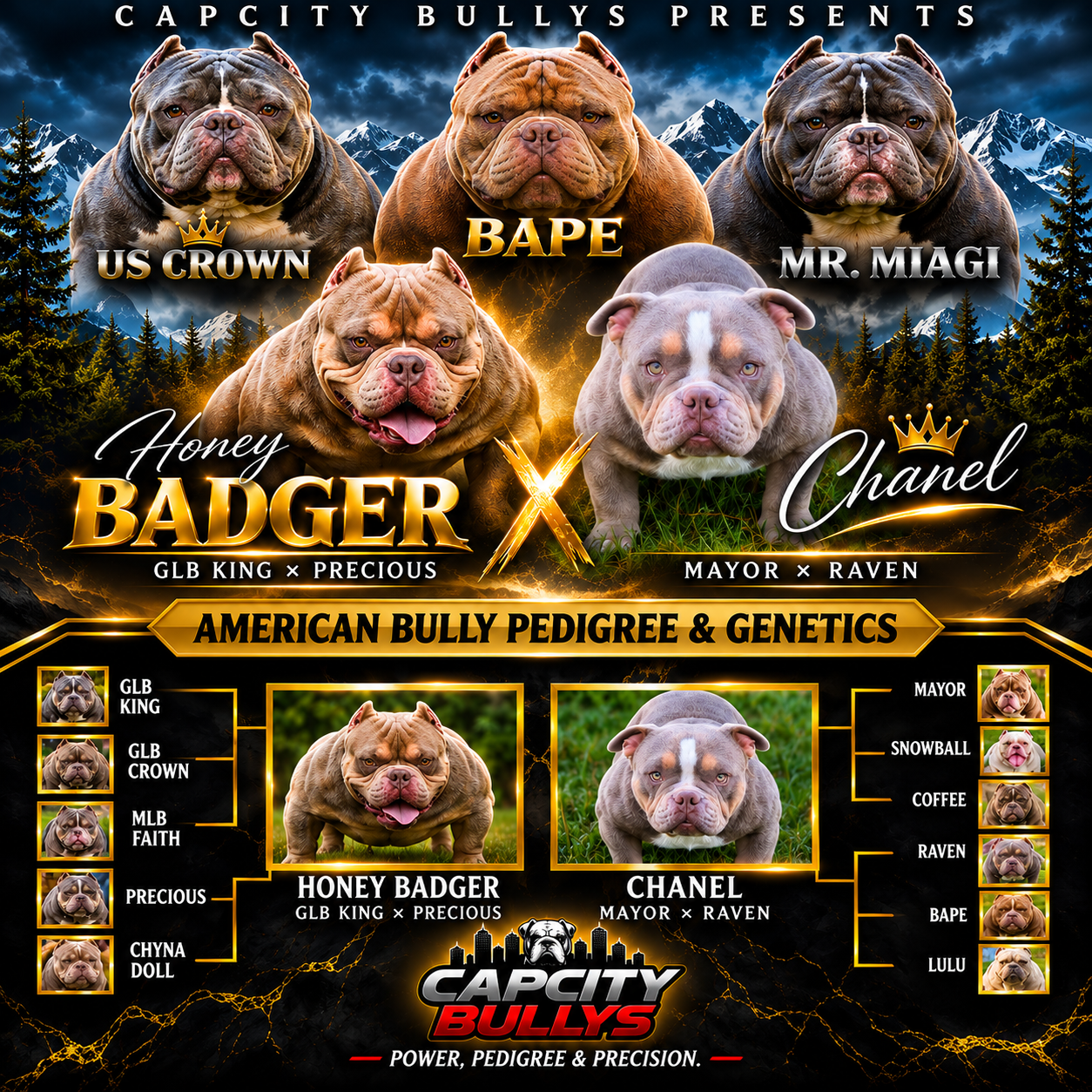
Our Honey Badger × Chanel pedigree spotlight brings attention to Crown and Bape ancestry within the same breeding combination.
Honey Badger carries 2× Crown ancestry, while Chanel carries 2× Bape ancestry.
For breeders who study pedigrees, these relationships provide an opportunity to examine how established family lines are combined.
The presence of these ancestors is part of the pedigree story, but the quality of the combination ultimately depends on the health, structure, temperament, and genetic compatibility of the individual dogs.
Understanding Linebreeding, Inbreeding, and Outcrossing
When studying American Bully bloodlines, breeders often encounter terms such as linebreeding, inbreeding, and outcrossing.
These describe different approaches to selecting breeding pairs based on ancestry.
What Is Linebreeding?
Linebreeding involves mating dogs that share one or more ancestors, often with the goal of maintaining particular family characteristics.
For example, a pedigree described as 2× Bape indicates that Bape appears twice within the recorded ancestry.
However, that notation does not tell the full story.
The significance of repeated ancestry depends on how many generations back the ancestor appears, how the dogs are related, and what other ancestors are present.
Linebreeding can increase the likelihood of inheriting certain characteristics, but it can also increase the chance that harmful recessive variants are inherited from both parents.
What Is Inbreeding?
Inbreeding involves mating genetically related dogs.
The closer the relationship, the greater the potential for increased homozygosity, which can raise the risk of inherited disorders and reduced genetic diversity.
Breeders should understand these risks rather than assuming that concentrating a desirable bloodline always improves a breeding program.
What Is Outcrossing?
Outcrossing generally refers to breeding dogs from less closely related families or lines.
Depending on the pedigrees involved, outcrossing may help increase genetic diversity.
However, outcrossing does not automatically guarantee healthy puppies, just as linebreeding does not automatically guarantee consistency.
Both approaches require careful evaluation.
Why the Coefficient of Inbreeding Matters
The coefficient of inbreeding (COI) estimates the probability that two copies of a gene are identical by descent.
It can help breeders understand genetic relatedness within a pedigree.
A COI calculated from a limited number of pedigree generations may underestimate more distant shared ancestry. Genomic information, when available, can provide additional insight.
At Capcity Bullys, we believe pedigree knowledge is most useful when combined with responsible health evaluation and an understanding of genetic risk.
How Capcity Bullys Evaluates a Breeding Combination
Our approach begins with the individual dogs rather than simply matching famous names.
A breeding combination should have a clear purpose.
We consider several factors when evaluating our program.
Pedigree Compatibility
We study the ancestry of both dogs and identify important family relationships.
This includes examining repeated ancestors, established bloodline influences, and available information about previous generations.
Structural Balance
A compact American Bully should still possess proportions that support comfortable movement.
We value strong breed characteristics without making exaggerated size or appearance the only priority.
Temperament
We consider the temperament of both dogs and the type of companion we hope to produce.
Stable, manageable behavior remains important regardless of pedigree.
Health Information
We consider available veterinary history, relevant screening, and known concerns that may affect breeding decisions.
Health evaluation is an ongoing responsibility rather than a one-time promise.
Long-Term Program Development
Each breeding should contribute to a broader understanding of our dogs and their characteristics.
We study previous litters and the development of related dogs to make more informed decisions about future generations.
Capcity Bullys Breeding Examples: Bloodlines in Action
Understanding bloodlines becomes easier when looking at real dogs within a breeding program.
Here are several examples from Capcity Bullys.
Icon × Storm — Combining Miagi, Devilspit, and Bullsace Influence
Icon is a compact Micro American Bully stud carrying Giagi/Miagi and Devilspit ancestry.
Storm is a Youngblood daughter and Bullsace granddaughter.
Together, their pedigrees bring different established American Bully influences into one combination.
The Icon × Storm litter includes puppies such as Chanel, Kingston, Legend, and Onyx.
Studying these dogs as they develop helps illustrate how ancestry, individual variation, and selective breeding interact.
Cyber × Raven — Combining Multiple Established Bloodlines
Cyber carries Hulk Hogan/Hulk Smash ancestry alongside additional American Bully influences.
Raven carries doubled-up Bape ancestry.
Their combination provides another example of how multiple family lines can come together within a breeding program.
Evaluating the puppies requires looking beyond the pedigree to their individual development, temperament, and structure.
Honey Badger × Chanel — Crown and Bape Pedigree Influence
The Honey Badger × Chanel combination highlights two recognizable bloodline influences:
- Honey Badger: 2× Crown
- Chanel: 2× Bape
For pedigree enthusiasts, this is an interesting combination because it brings established ancestry from both sides into one planned pairing.
However, our evaluation does not stop with the names.
The most important considerations remain the actual characteristics, health information, and compatibility of the dogs involved.
Pedigree provides the background. The individual dogs determine the quality of the breeding decision.
Why Famous Bloodlines Don’t Automatically Produce Exceptional Puppies
American Bully enthusiasts often recognize certain names immediately.
A dog may be advertised as a descendant of Bape, Miagi, Bullsace, Crown, or another influential ancestor.
But a recognizable pedigree is only one part of evaluating quality.
A famous bloodline cannot guarantee:
- Perfect structure
- Freedom from inherited disease
- A particular adult size
- A specific temperament
- Identical characteristics among littermates
- Success as a future breeding dog
Genetic inheritance involves many genes, environmental influences, and developmental factors.
Two puppies from the same litter may mature differently.
This is why we encourage prospective owners and breeders to study the individual dog, its parents, and the broader breeding program.
American Bully Bloodlines vs. American Bully Quality
Pedigree and quality are related concepts, but they are not interchangeable.
A pedigree documents ancestry.
Quality involves evaluating the dog’s actual characteristics and suitability for its intended role.
For a family companion, important considerations include temperament, health, manageable physical characteristics, and compatibility with the household.
For breeding decisions, additional considerations include genetic diversity, inherited health risks, structure, and the long-term consequences of passing particular traits to future generations.
At Capcity Bullys, our goal is not simply to produce dogs with recognizable pedigrees. It is to make thoughtful decisions about the dogs behind those pedigrees.
What Buyers Should Know About American Bully Bloodlines
Buyers do not need to become geneticists to make informed decisions.
However, understanding a few basic pedigree concepts can help when comparing breeders.
Before choosing an American Bully puppy, consider asking:
- Can I review the puppy’s pedigree?
- Who are the parents and grandparents?
- Are there repeated ancestors in the pedigree?
- What health concerns are known within the family?
- What health testing has been performed on the parents?
- How do the parents move and behave?
- What characteristics was the breeding intended to preserve or improve?
- How have related dogs developed as adults?
A responsible breeder should be able to discuss the strengths and limitations of a breeding combination without relying exclusively on famous names.
Families interested in learning more about American Bully ownership can also explore American Bully Breed for additional educational resources.
Frequently Asked Questions About American Bully Bloodlines
What are the most famous American Bully bloodlines?
American Bully enthusiasts frequently discuss influential names and families such as Razor’s Edge, Gottiline, Dax, Miagi, Bape, and other prominent dogs or breeding programs. Their historical significance and influence vary across different branches of the breed.
What does 2× Bape mean in an American Bully pedigree?
It generally means Bape appears twice within the recorded pedigree. The genetic significance depends on the position of those appearances and the relationships among the other ancestors.
Is linebreeding better than outcrossing?
Neither method is automatically superior. Both have potential advantages and risks. Health information, genetic diversity, pedigree accuracy, and the suitability of the individual dogs should guide breeding decisions.
Does a famous bloodline make an American Bully more valuable?
Pedigree recognition can influence interest among enthusiasts, but it does not independently establish a dog’s health, quality, or suitability. Buyers should evaluate the individual dog and the breeder’s practices.
Can bloodlines predict a puppy’s adult appearance?
Pedigree and information about relatives may help estimate likely characteristics, but they cannot guarantee a puppy’s eventual height, proportions, or appearance.
What bloodlines does Capcity Bullys work with?
Our breeding program includes influences from Bape, Bullsace, Devilspit, Miagi/Giagi, Youngblood, and other established American Bully pedigrees. Specific ancestry varies by dog and breeding combination.
The Future of American Bully Bloodlines at Capcity Bullys
Building a consistent breeding program requires patience, observation, and a willingness to learn from every generation.
We believe the future of the American Bully should be shaped by responsible decisions that balance recognizable breed characteristics with health, temperament, genetic awareness, and functional structure.
At Capcity Bullys, our commitment is to continue studying the pedigrees behind our dogs, evaluating their development, and making informed decisions about the direction of our program.
Power represents the distinctive strength and presence of the American Bully.
Pedigree represents the generations of ancestry and genetic knowledge behind each dog.
Precision represents the care and responsibility required to make thoughtful breeding decisions.
Together, these principles define our philosophy.
Capcity Bullys — Power, Pedigree & Precision.
Continue Exploring American Bully Education
The American Bully Breed — Explore structure, genetics, health testing, and responsible breeding through our educational academies.
American Bully Breed — Learn more about American Bully ownership, puppy development, and breed characteristics.
The Micro Bully Breed — Explore Micro Bully structure, ownership, health considerations, and comparisons.
Capcity Bullys Available Puppies — Learn about our current American Bully puppies and breeding program.